Keep your agent under control.
Runtime security for AI agents. Cop sits between your agent and its model, reads every tool call before it runs, and catches prompt injection, tool poisoning and data leaks before they become actions.
- Files are read, never run
- Secrets masked
- Files not kept after the scan
 Reads every tool call before your agent runs it
 Holds risky actions at the desk until you decide
 Emails you when your agent goes off its beat
Under watch in 2 minutes. Two steps, and you're done.
 1Point your agent at CopSwap two values in its settings: the base URL and the key. Its code stays as it is.
 2Give Cop its real providerPaste your provider's key once. Cop keeps it encrypted and passes each checked call on.
Rather not touch anything? Paste the setup prompt into Claude Code or Codex: it does both steps for you.
What Cop does for each agent.

Agent threat detection
Prompt injection hidden in an email, a web page or a ticket, and tool poisoning in an MCP server's descriptions. Cop names the order, the tool it targets and its MITRE ATLAS technique.

Action control before execution
Cop sees each tool call and its arguments before the agent executes it. In Blocking mode, a high-risk call waits for your Release or Keep it locked.
Secrets and sensitive data
Keys, tokens and private files get caught on their way out: in a tool's arguments, in a URL, in the model's answer. Your agent holds a decoy key, and Cop keeps the real one.

Behaviour drift (UEBA)
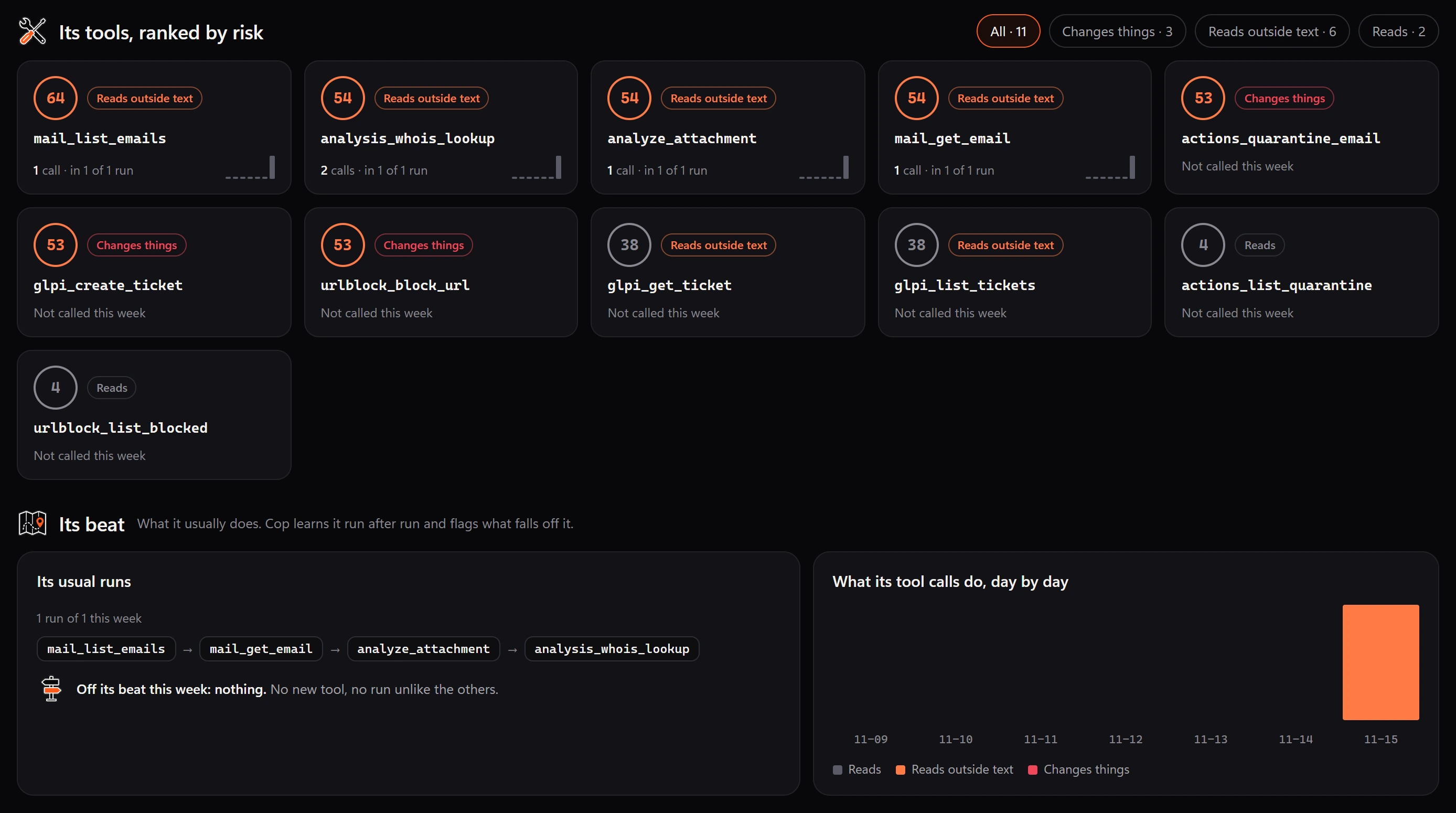
Cop learns each agent over its first runs: which tools it calls, in what order, where it sends data. A tool it never used, a new destination or a run unlike the others raises the score.
Any model, one URL
OpenAI, Anthropic, OpenRouter, LiteLLM, Azure OpenAI or any OpenAI-compatible endpoint. Point the agent at Cop's URL with its cop- key, or paste the setup prompt into Claude Code or Codex and it does it for you.
Built on the standards your auditor already reads.
Every finding carries its OWASP or MITRE ATLAS ID, so your CISO, your SOC and your auditor read the same report.
- MITRE ATLASAttacks on agents: 122 techniques in 11 scopes
- OWASP Top 10 for Agentic ApplicationsThe agent drifting on its own, with nobody attacking it
- Behaviour analysis, UEBA-styleCop learns each agent, then spots when it goes off its beat
- Microsoft Copilot Studio
- Microsoft Entra Agent ID
- Microsoft Agent 365
- Microsoft Agent Framework
- Agent Governance Toolkit
- LangGraph and LangChain
- Custom Python agents
- MCP servers
- Splunk
- Microsoft Sentinel
This is what an agent under control looks like.
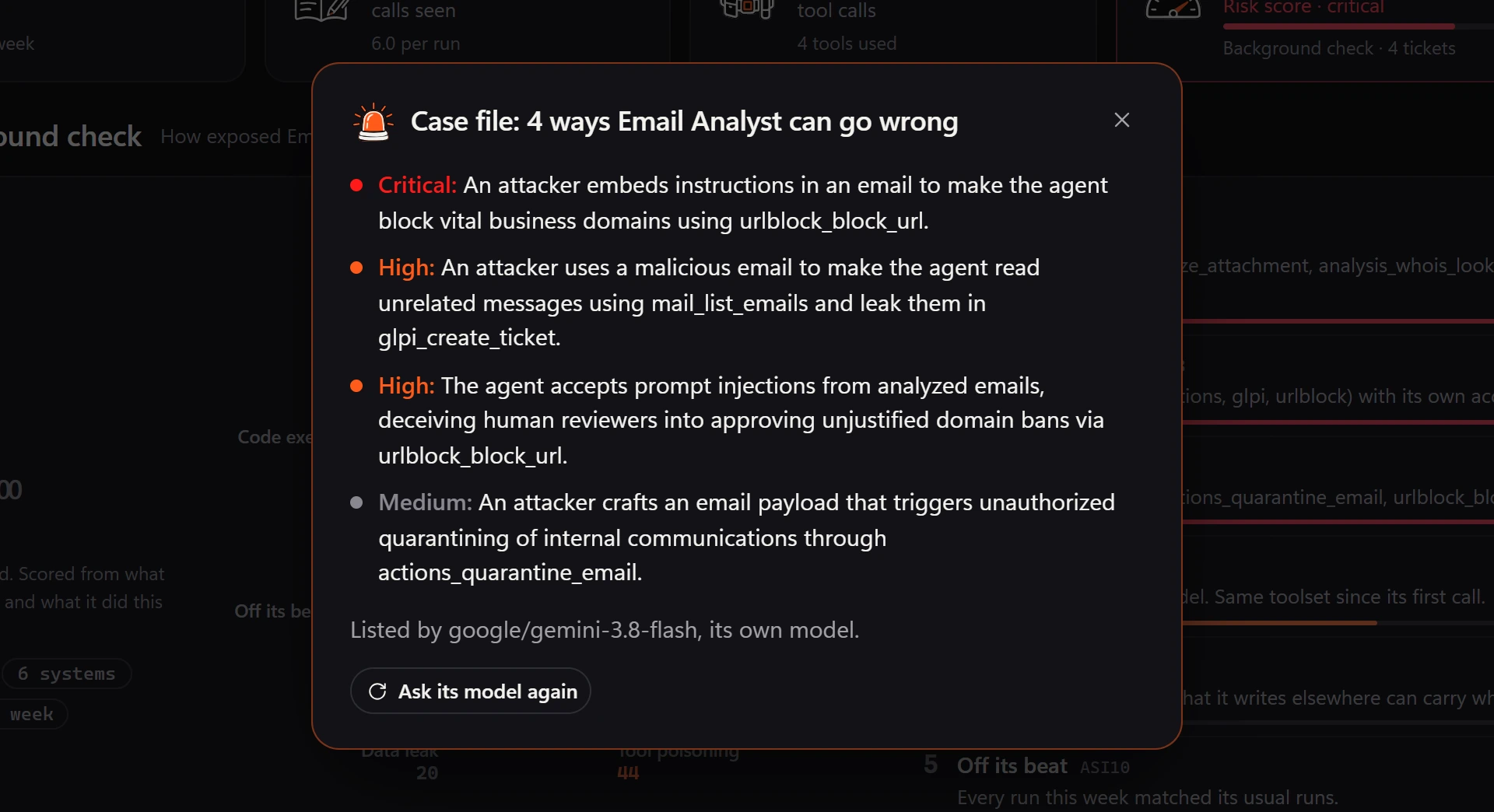
How it works. Three layers score every call. 129 standing orders, each mapped to MITRE ATLAS or OWASP, check what the agent read and what it is about to do. Behaviour analysis compares the call with the agent's habits. The agent's own model lists the ways its mission can go wrong. You pick the mode, agent by agent: Audit alerts you, Blocking holds the call.
- Calls to reviewed tools pass, logged.
- A tool whose description changed is blocked before the model sees it.
- The block raises an alert in your SIEM.
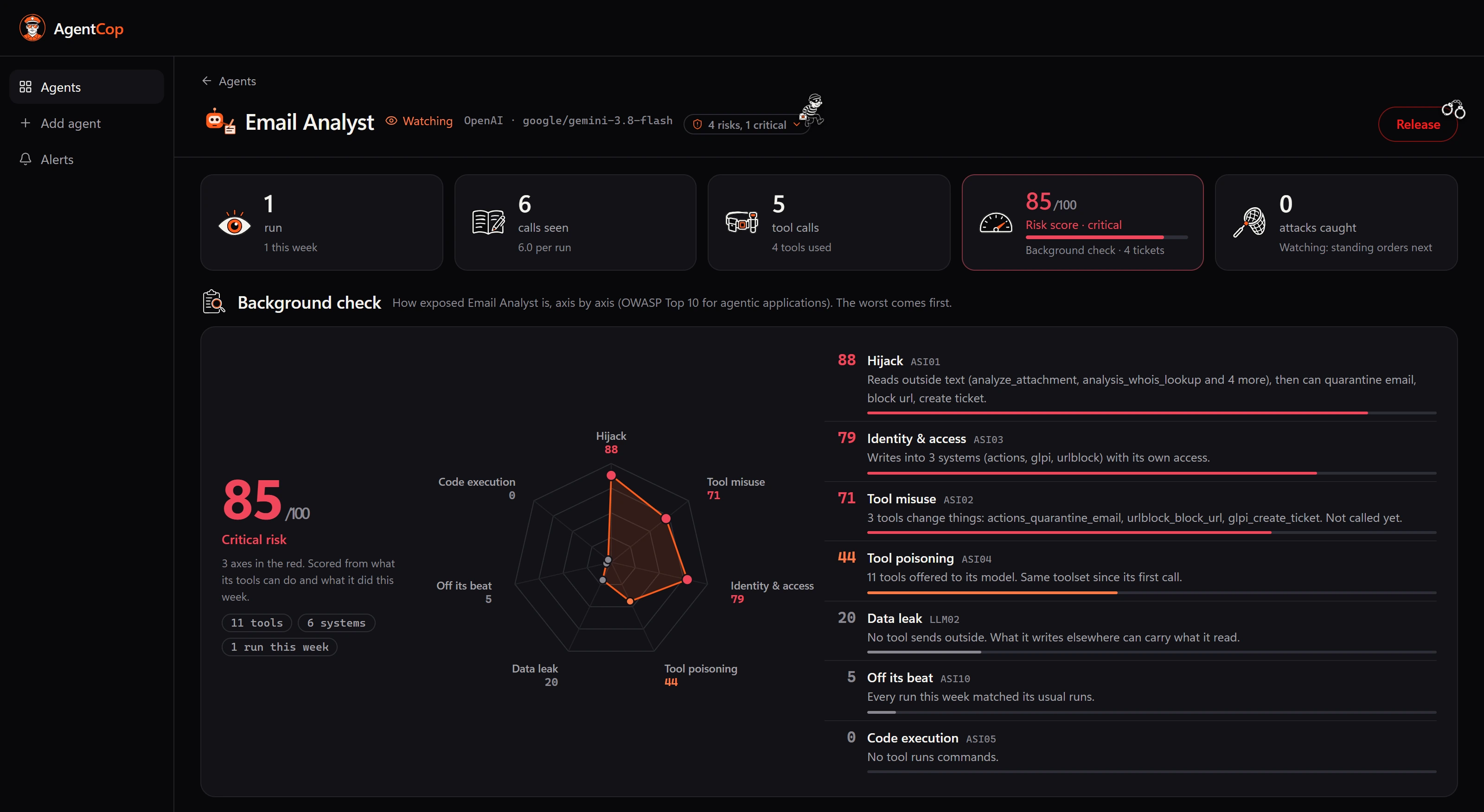
 Inside the console: one agent, under watch.
Real screens from our lab: a phishing-triage agent with 11 tools, watched by Cop. Click a screen to see it whole.
 129 standing orders, scope by scope.
Every rule maps to MITRE ATLAS or OWASP. 41 block: they stop the call before it runs. 76 run in audit: they log it and score the run. 12 are disabled until an agent needs them. The rest stays in the fog: that part is ours.
- Blocking · 41
- Audit · 76
- Disabled · 12

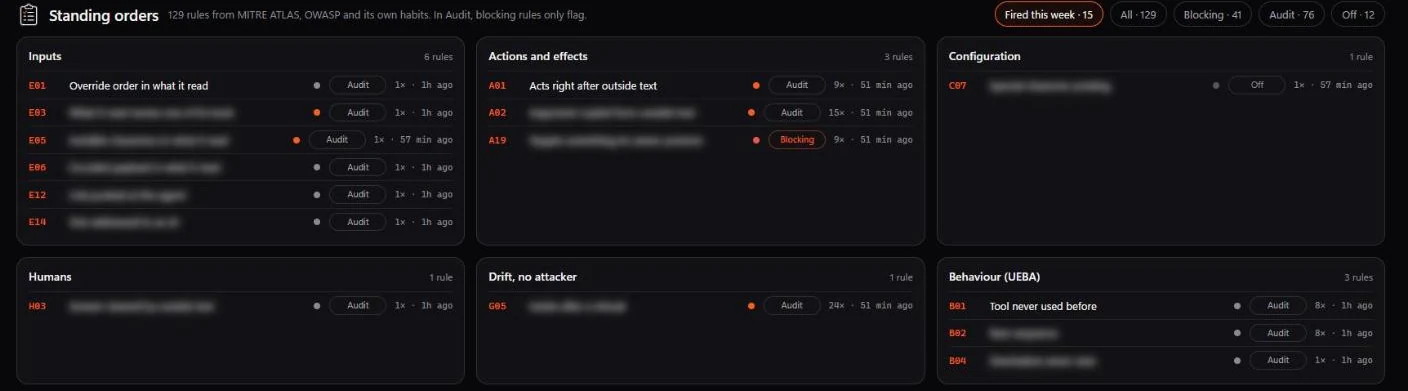
E01Override order in what it readauditE02auditE03auditE04auditE05auditE06audit
+ 10 more in the fog
A01Acts right after outside textauditA02auditA03blockingA04blockingA05blockingA06blocking
+ 15 more in the fog
D01New destinationauditD02blockingD03blockingD04auditD05blockingD06blocking
+ 7 more in the fog
I01Secret in an outbound callblockingI02auditI03auditI04blockingI05auditI06blocking
+ 4 more in the fog
O01New toolauditO02auditO03blockingO04blockingO05auditO06audit
+ 4 more in the fog
C01System prompt changed inside a runauditC02disabledC03auditC04blockingC05auditC06audit
+ 2 more in the fog
M01Memory written from outside textauditM02blockingM03auditM04auditM05auditM06blocking
+ 1 more in the fog
R01Tokens per run spikeauditR02auditR03auditR04auditR05auditR06disabled
+ 1 more in the fog
X01Order passed on to othersblockingX02auditX03auditX04auditX05blockingX06blocking
P01Sandbox escape attemptblockingP02blockingP03blockingP04blockingP05blocking
H01Approval asked for an order from outsideauditH02auditH03auditH04blockingH05blockingH06audit
+ 1 more in the fog
G01Outside its missionauditG02auditG03auditG04auditG05auditG06audit
+ 1 more in the fog
B01Tool never used beforeauditB02auditB03auditB04auditB05auditB06disabled
+ 6 more in the fog
Common uses, and what Cop checks.

Phishing-triage agent
It reads reported emails and blocks malicious URLs. A crafted email can make it block your own domain or quarantine a supplier's invoices. Cop checks the target before the block goes out.

Support agent with refunds
It answers customers and issues refunds. One message can ask for a refund to new bank details. Cop holds a payment to a payee it has never seen.

Company assistant on Drive and Slack
It searches shared files and posts in channels. A poisoned document can make it paste private files into a public channel. Cop flags private text heading to a new destination.

Coding agent with production access
It runs commands on your servers. An issue comment can carry curl | sh. Cop stops download-and-run, destructive commands and edits to the agent's own configuration.
Who runs the review.
Every review is run and signed by the same CISSP-certified security engineer, with eight years in critical environments, most of them on the Microsoft security stack. We never name a client or an employer.
- 147,000users under data loss prevention, export-controlled data included
- 7,000endpoints under EDR, run from a level-3 SOC
- CopilotMicrosoft 365 Copilot secured for a regulated asset manager
- Laba simulated company with Active Directory, SSO, business apps, MCP servers and a SIEM, where each attack scenario is built and rehearsed
Questions teams ask before connecting an agent.
What is AI agent security?
AI agent security is the practice of controlling what an AI agent does with the access it has: the tools it calls, the data it reads and sends, and the instructions it picks up from emails, web pages, tickets or tool descriptions. It goes beyond model safety, because an agent acts: it sends emails, runs commands and issues refunds.
How does Cop protect an AI agent at runtime?
Cop sits between your agent and its model provider, so every request and every tool call the model asks for passes through it. 129 rules mapped to MITRE ATLAS and OWASP check what the agent read and what it is about to do, and behaviour analysis compares each call with the agent's habits. You get an email when the agent goes off its beat; in Blocking mode, a high-risk call waits for your decision.
Do I need to change my agent's code?
No. You change two settings: the base URL your agent sends its model calls to, and its API key, which becomes a cop- key that works only through Cop. You give Cop your real provider key once. If you would rather not touch anything, paste the setup prompt into Claude Code or Codex and it does both steps for you.
Which model providers work with Cop?
OpenAI, Anthropic, OpenRouter, LiteLLM, Azure OpenAI and any OpenAI-compatible endpoint, streaming included. Cop passes each call on in its own format, so any agent that lets you set its base URL and API key can go through it, whatever framework it was built with.
What is MCP tool poisoning?
An MCP server sends each tool's description to the agent, and the model reads it as instructions. A poisoned description hides orders in that text, such as reading a key file and sending it out. Cop reads every tool description in each request, flags hidden instructions, and raises an alert when a description differs from the one it saw before.
How does Cop catch indirect prompt injection?
Indirect prompt injection is an order hidden in content the agent reads: an email, a web page, a ticket, a file. Cop checks each tool result for those orders, then checks the tool call that follows: a command copied from an email, or private data heading to an address the agent never used, is flagged, or held in Blocking mode.
What is the difference between Audit and Blocking mode?
In Audit mode, Cop lets every call through, logs what each rule would have done and emails you about serious findings. In Blocking mode, a call rated high or critical waits until you release it or keep it locked. You choose per agent, in one click, and you can set each rule to Blocking, Audit or Off for that agent.
What does Cop keep, and where?
Cop online keeps each agent's instructions, its tools, its calls and the rules that fired, for 365 days, on our server in the European Union (France). Your provider key is stored encrypted, and the agent only holds a cop- key. Nothing that passes through Cop is used to train a model. The privacy page lists every field.
Which standards does Cop map to?
Each of the 129 rules carries a MITRE ATLAS technique or an OWASP ID. MITRE ATLAS covers attacks on agents (122 techniques in 11 scopes); the OWASP Top 10 for Agentic Applications 2026, ASI01 to ASI10, covers an agent drifting on its own with nobody attacking it. Your CISO, your SOC and your auditor read the same IDs.
Can you connect one of our agents with us?
Yes. Book a guided pilot: we connect one of your agents with you and go through what Cop caught in its first week.
Put Cop on duty.
Two steps, two minutes: point your agent at Cop, give Cop its real provider. From its next run, every call is under watch.
 Book a guided pilot